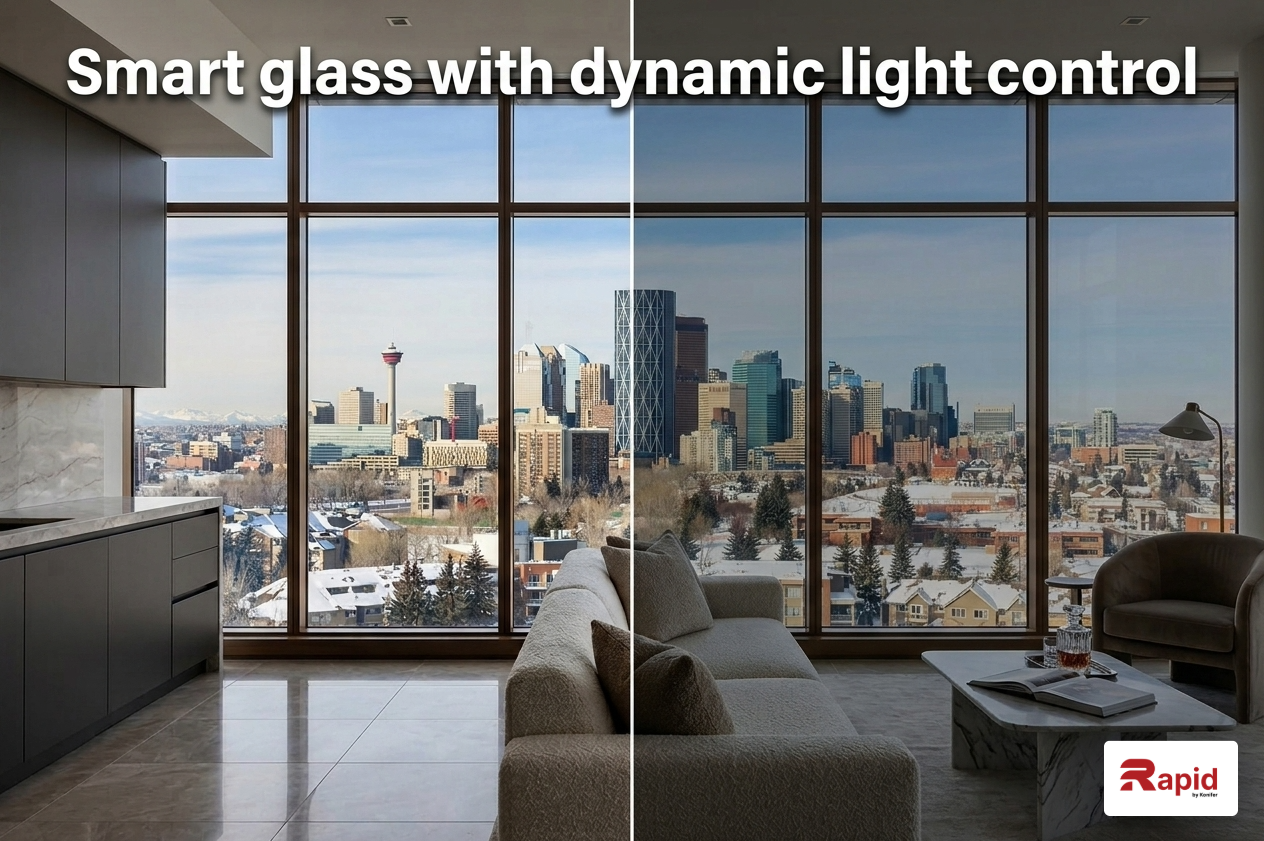
Smart glass—also known as switchable glass, dynamic glass, or dynamic glazing—refers to an advanced category of architectural materials that dynamically alter their light transmission properties in response to electrical voltage, ambient light, or heat. By transitioning between transparent, tinted, and opaque states, smart glass converts static building envelopes and interior partitions into active climate and privacy management systems.
1. Primary Smart Glass Technologies
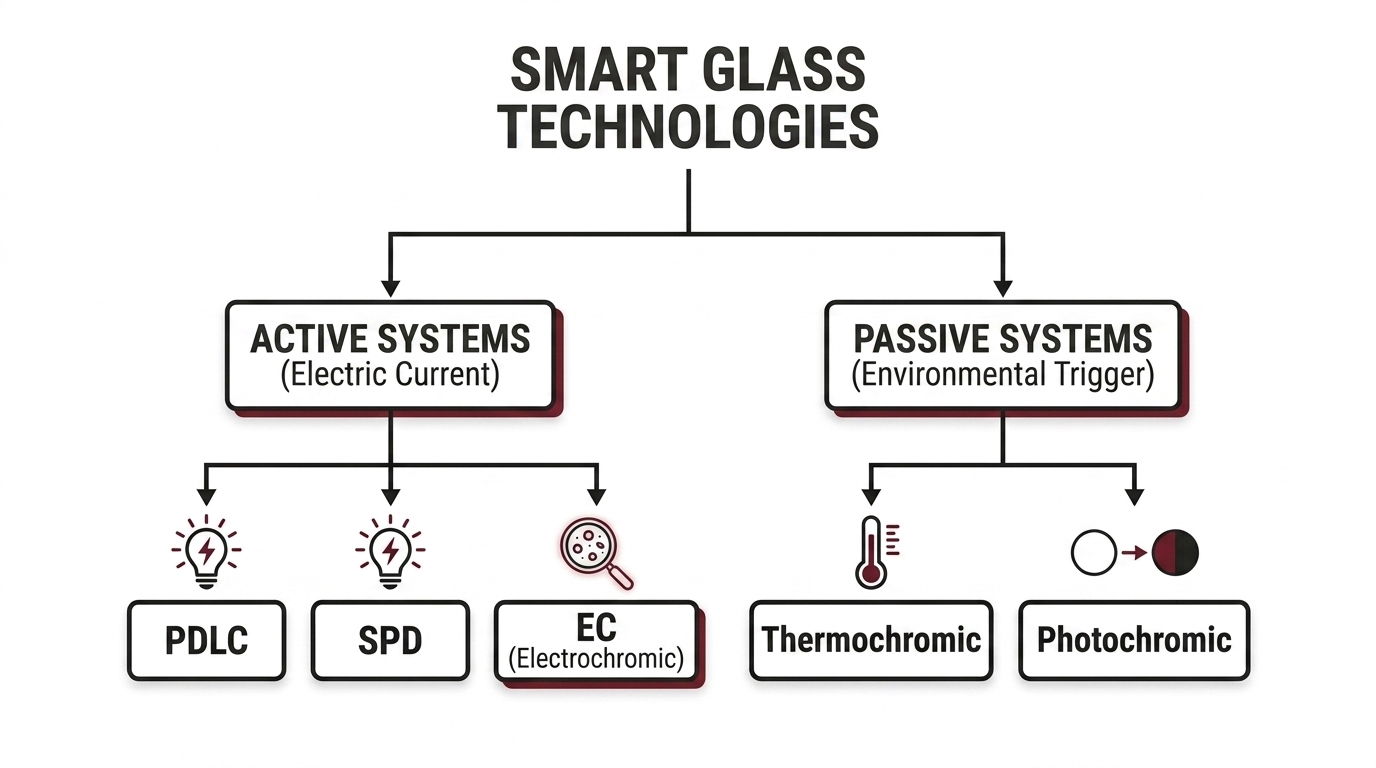
Smart glass technologies fall into two primary operational categories: active (requiring an electrical power source to change state) and passive (reacting automatically to environmental conditions like heat or solar intensity).
Active Technologies (Electrically Controlled)
Polymer Dispersed Liquid Crystal (PDLC): Consists of liquid crystal droplets dispersed within a polymer matrix sandwiched between two conductive ITO (Indium Tin Oxide) layers. When unpowered, the liquid crystals are randomly oriented, scattering light to create an opaque, frosted appearance. When electricity is applied, the crystals align instantly, allowing light to pass through for clarity.
Suspended Particle Device (SPD): Utilizes microscopic particles suspended in a liquid medium laminated between glass panes. Without power, the particles are randomly positioned, blocking up to 99% of incoming light. Under electrical voltage, the particles line up, rendering the glass clear or partially tinted.
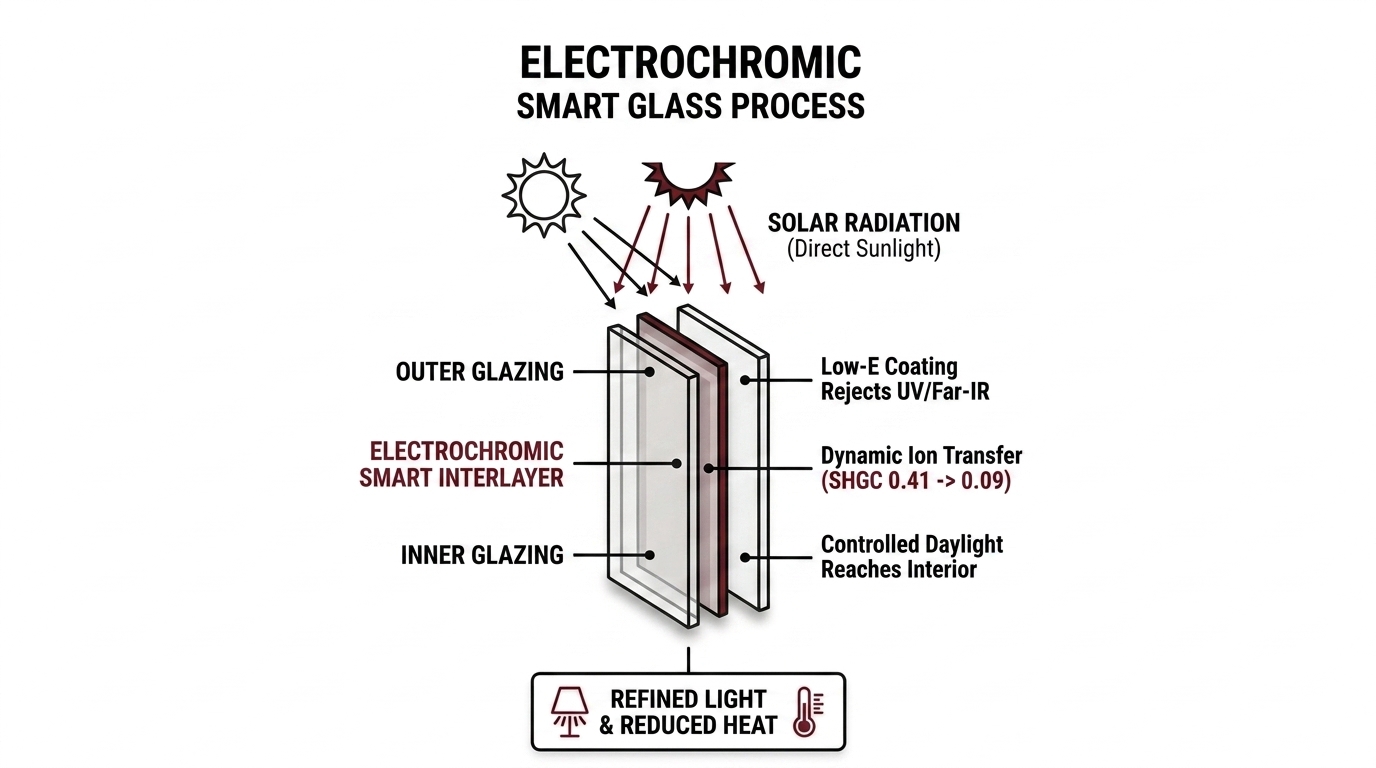
Electrochromic (EC): Employs thin-film oxide layers (such as tungsten oxide) that transfer lithium ions between electrodes under low voltage. This chemical shift causes the glass to gradually tint dark blue or gray. EC glass retains its tint level without requiring continuous power, consuming energy only during state transitions.
Passive Technologies (Self-Adjusting)
Thermochromic Glass: Responds automatically to surface temperature increases caused by direct sunlight. As ambient heat rises, internal chemical interlayers darken to block solar radiation without electrical wiring.
Photochromic Glass: Darkens in direct response to ultraviolet (UV) light intensity, operating identically to photochromic eyeglass lenses.
Technical & Functional Comparison
| Technology | Default State (Off) | Powered State (On) | Primary Benefit | Dominant Application |
| PDLC | Frosted / Opaque | Fully Clear | Instant Privacy | Office Partitions, Showers, ICU Doors |
| SPD | Dark Tinted | Clear / Variable Tint | Glare Control & Shading | Skylights, Automotive Sunroofs, Façades |
| Electrochromic | Clear or Light Tint | Deep Blue/Gray Tint | Maximum Energy Efficiency | Commercial Building Envelopes |
| Thermochromic | Clear | Automatically Tinted | Low-Complexity Solar Control | Unwired Exterior Glazing |
2. Key Performance Metrics & Energy Efficiency
Smart glass replaces mechanical blinds and fixed shading systems by dynamically managing the Solar Heat Gain Coefficient (SHGC) and Visible Transmittance (VT) of a building envelope.
Core Glazing Metrics
Solar Heat Gain Coefficient (SHGC): Measures the fraction of solar radiation admitted through a window. High-performance electrochromic Insulated Glass Units (IGUs) can reduce SHGC from 0.41 in their clear state down to 0.09 when fully tinted, blocking over 90% of solar heat gain.
Visible Transmittance (VT): Indicates the percentage of visible light passing through the glass. Smart glass allows dynamic modulation (e.g., from 60% VT down to 1% VT), preserving exterior views while eliminating glare.
U-Value (Thermal Transmittance): Indicates overall heat transfer performance. When integrated into double- or triple-pane IGUs filled with argon gas, smart glass maintains low U-values (0.20 to 0.28 Btu/h·ft²·°F or 1.1 to 1.6 W/m²K).
Energy Savings Impact
HVAC Peak Load Reduction: Lowering solar heat gain during peak hours reduces commercial cooling demands by 20% to 30%.
Lighting Offset: Dynamic daylighting allows smart glass to remain clear when glare is low, reducing artificial lighting energy consumption by up to 18%.
Building Standards: Smart glass contributes directly to LEED v4/4.1 points across Energy & Atmosphere (EA), Indoor Environmental Quality (EQ), and Innovation categories, as well as WELL Building Standard daylight and thermal comfort concepts.
3. Commercial & Architectural Applications
Commercial Real Estate & High-Rise Façades: Electrochromic glazing on curtain wall systems eliminates motorized blinds, optimizes energy consumption, and reduces interior thermal hot spots along perimeter office spaces.
Corporate Interiors & Conference Rooms: PDLC switchable glass allows open-concept office spaces to transition into private boardrooms at the click of a switch or via automated wall controllers.
Healthcare Facilities: PDLC partitions replace fabric privacy curtains in hospital intensive care units (ICUs) and patient rooms. Traditional curtains harbor pathogens; non-porous smart glass surfaces can be sanitized instantly.
Hospitality & Residential: High-end residential builds and luxury hotels integrate switchable glass in exterior windows, bathroom enclosures, and balcony doors to combine panoramic views with instant privacy.
4. Cost Breakdown & ROI Analysis
Smart glass pricing varies based on whether the solution involves smart film (applied to existing glass as a retrofit) or factory-laminated smart glass panels integrated into new Insulated Glass Units (IGUs).
National Average Cost Estimates
| Product / Service Type | Material Cost (per sq ft) | Total Installed Cost (per sq ft) | Key Cost Drivers |
| Smart Film (Retrofit PDLC) | $30 – $50 USD | $65 – $100 USD | Self-adhesive backing, wiring trim, low installation labor. |
| PDLC Smart Glass Panels | $80 – $120 USD | $140 – $220 USD | Factory lamination, glazier installation, electrical transformers. |
| SPD Smart Glass Panels | $90 – $140 USD | $160 – $250 USD | Complex liquid particle film, specialized power controllers. |
| Electrochromic Glazing (IGU) | $100 – $160 USD | $180 – $300+ USD | Low-E multi-layer sputter coatings, BMS network integration. |
Additional Project Cost Factors
Electrical & Control Subsystems: Hardwired multi-zone controllers, transformers, wall switches, and Building Management System (BMS) interfaces add $120 to $350 per control zone.
Glazing Installation & Freight: Heavy laminated panels require specialized glazier labor ($65 to $95/hr) and white-glove shipping for oversized panels (> 96 inches).
Integration Fees: Connecting smart glass automation to platforms like Crestron, Lutron, or BACnet networks involves custom API programming fees ranging from $150 to $400.
Simple Return on Investment (ROI) Timeline
While standard commercial double-glazing costs around $35–$65 per square foot installed, smart electrochromic glass requires a higher initial capital expenditure. However, operational savings offset this differential:
$$\text{Net Annual Savings} = \text{Cooling Reduction} + \text{Lighting Savings} + \text{Blind Maintenance Avoidance}$$
For commercial office buildings in high-solar climates, energy savings and reduced HVAC mechanical sizing typically yield a payback period of 6 to 9 years, with an operational panel lifespan exceeding 20 to 25 years.
5. Architectural Considerations & Expert Insights
Implementing smart glass successfully requires coordination between architectural design, electrical engineering, and glazing contractors.
Technical Implementation Checklist
Power Routing & Bus Bars: Active smart glass requires concealed electrical wiring running through the window framing or mullions. Frame extrusions must be pre-drilled to accommodate cable exit points without compromising weather seals.
Electrical Safety Requirements: Interior wet locations (such as glass shower doors or healthcare suites) require low-voltage transformers (24V–48V AC) paired with Ground Fault Circuit Interrupter (GFCI) protection.
Optical Clarity & Haze Ratings: PDLC technology exhibits a minor off-axis visual haze (typically 3% to 6%) due to light refraction through liquid crystal polymer matrices. High-visibility perimeter glass applications must select low-haze formulations to ensure maximum transparency.
Industry Insight:
“The future of high-performance architectural glazing lies in the convergence of passive thermal performance and active control. By pairing low-emissivity coatings with dynamic tinting, building envelopes can respond intelligently to real-time weather changes, turning static curtain walls into energy-generating, light-optimizing assets.”